Drums
I've been taking "real" drum lessons for a couple years now. I say real in the sense that I'm being taught on the fundamentals of drums by a professional instructor with 50 years of experience, rather than impulsively chasing after a fleeting desire to play some pop music. Disclaimer: I'm not good. I spend pitifully little time on it (~20 minutes a day) to even be called proficient anytime soon. But I've had enough exposure to be able to at least describe the many fascinating aspects of drumming.
I'm not a musical person. As for playing instruments, I tried piano as a kid but found myself asking what's the point of playing the same piece over and over again. As for listening to music, I don't even have favorite bands or a list of classical pieces. I do firmly believe in the supreme communicative power of music: it's the only medium certain information can be transmitted. It's often the most crucial component in storytelling (e.g., Anastasia, Nier). But it should be evident that classifying me as a musician is a laughable mistake.
That said, I've always been attracted to drums. I've always pursued activities that require delicate hand skills like writing and drawing. Drums require complex maneuvering of the sticks. The hand is one of the most incredible engineering marvels in the human body, and these activities push the limit of what it can do. I also love the simplicity, in a similar way that I prefer abstract paintings over realisitc ones. Drums strip auditory signals down to the bare bones, leaving only the underlying pulse.
The five dimensions of drums
"Doing one thing with one limb and another with a different limb" (drumming as described by non-drummers) is only one of the five dimensions of drums:
- Tempo: Anyone can hit drums. What makes drummers drummers is that they can keep the tempo—consistently.
Moreover, every note must be hit within a hair-width "pocket" around where it should come. Realize that this is challenging
- Regardless of how slow the music is
- Regardless of how simple the pattern is
- Even if you're just using one hand
- Technique: Proper techniques are required to handle a nontrivial tempo (e.g., it's physically impossible to play fast otherwise).
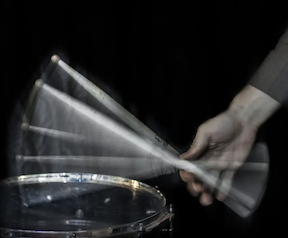
Two particularly important techniques are rebounds and pivoting on the thumb (see the picture above).
- Rebounds: Consider dribbling a basketball. You throw the ball down, but you catch the ball when it bounces back (i.e., you don't lift up the ball yourself). Likewise, you rebound in drums by "throwing" the stick down and catching it when it bounces back.
- Pivoting on the thumb: A fulcrum refers to the location where the stick pivots. Without training, you primarily use the elbow (or worse, the shoulder) as the fulcrum which involves large movements. With training, you can use the wrist which is far more efficient. With substantial training, you can use the thumb as the fulcrum (exposition by Tommy Igoe).
- Limb coordination for patterns: This is what most people think of "playing drums"—the ability to play different patterns under different limbs. The difficulty grows exponentially in the number of limbs involved, with larger constants for the feet. Curriculum training is often effective (e.g., you practice each limb separately, then in groups of two, until you can play all together).
- Limb coordination for volumes: You need to be able to control the volume of each limb indendently of one another. You will sound terrible if you hit the fast hi-hat cymbol as forcefully as you hit the occasional crash. This is different from limb coordination for patterns, which can be done without regards to volumes.
- Reading and transcribing: You need to know how to read notes and understand how they are intended to be played if you want to benefit from existing resources, Conversely, if you want to play along some music, you need to learn how to listen carefully and transcribe the notes.
Feeling: the sixth dimension
Unfortunately, you can master all five dimensions and still sound terrible (more accurately, robotic) if you don't have the capacity to feel what you are playing. The concept of feeling is elusive, but it is the difference between making your body play vs playing yourself.
A more logical take on this phenomenon is as follows. "Feeling the groove" is the only way to execute the otherwise intractable combination of rhythms and intensities that "sounds good". Hypothetically, a person with unbounded physical abilities and mental processing powers should be able to plan such notes ahead and pull off playing them without feeling. But in practice, it's completely impossible. The only solution is to tap into your highly developed musical insticts by feeling the groove. Great musicians talk of the "trance" they fall into when they are in the moment being one with music. It is a world that's unseen by most people.
For instance, feeling is crucial to limb coordination. In graphical model terminology, feeling is the root node and the limbs are its child nodes (i.e., the limbs are conditionally independent given the feel), because feeling should generate a latent, silent, reliable pulse on which all the limbs depend. If there is no feeling, the limbs must depend on each other (e.g., snare on every third hi-hat) and/or some external time keeper. Playing "naturally" then becomes impossible.
Another example of feeling is the "length" of a note. In drums, a note is a hit. There is no length. However, feeling the length actually results in very different sounding notes! This is likely because the body automatically adjusts subtle details that are not consciously controllable to reflect this feel ("daaah-da-daaah-da" instead of "da, da da, da").
Feeling requires a certain degree of emotional investment. This is why I personally have a hard time with this hidden dimension, as I'm trained to suppress my feelings in all other contexts.
More surprises
Playing drums, or any instrument, is not art. It's athletics and a trade. In my drum instructor's own words, it's like being a "professional plumber". The similarities between training to be a drummer and training to be an athlete are striking:
- It's not about doing something new. You do the same drill over and over again.
You can spend a whole year just practicing the following three patterns (rudiments) in correct form on a practice pad with a metronome:
- (Single strokes) RLRLRLRL
- (Double strokes) RRLLRRLL
- (Paradiddles) RLRRLRLL
- There is no end. You're never done. You will never have "perfect rebounds" or "perfect pivoting on the thumb". All you can hope for is pulling it off in a better form more reliably by practice. You are to forever reduce the bias and variance of your performance, so that when the moment comes for you to perform, the chance of screwing up is 0.1% instead of 15%. But it will remain nonzero no matter how good you get.
- Once your muscles know what to do, it becomes largely a mental battle. What eventually blocks you from playing better is more neurological than physiological. This happens mostly in the form of strain. E.g., there no reason to strain your neck when you're pivoting on the thumb, but you do. The harder the challenge is, the more relaxed you need to be. Trying too hard is the surest way to fail. You have to relax, be outside yourself, and watch yourself perform stoically ("let the music flow through you").
My instructor loves to say: you either do or do not perform—there is no "trying". The paradox is that it frees you, since there's no point in trying, which in turns allows you to relax and thereby perform better. What if you do not perform? It just means you have some work to do first. Do that, and don't try.
Drumming is full of such paradoxes. Another one is the fact that your grip has to be loose enough to let the stick rebound and flow freely; and it also has to be strong enough to impose enough control. Achieving this balance at a fast tempo requires the pinnacle of athletic abilities the human hand is capable of.
Drumming makes me realize how asymmetric our bodies are. I'm very (very) strongly right-handed. My left hand is likely less than 50% as capable as my right hand. I'd be immediately a much more competent drummer if my left hand were as good as my right hand, but that's not the reality. I just need to explicitly optimize the non-dominant hand. But it will never be as good as the dominant hand.
Conclusions
Talking about drums will not make me better as a drummer (though it gives me a better mental organization of the subject). There's not much to "know about" drums. What's needed is practice, as is the case with any sport (e.g., there's not much to "know about" heavy lifting; you just need to do it).
I won't be a professional drummer in a million lifetimes. I'm also glad that I'm not—I rather enjoy NLP and ML too much to consider other specialties. But playing drums gives me a peek into the orthogonal world of musicians. It's a world made of athletic values and uncompromising trademanship. Researchers can learn from their values, for instance:
- Do good research, or do not. There's no trying.
- You have to learn to relax, and just do what you have to do to make progress. Let research flow through you. Being too strained (e.g., about deadlines and other pressures of life) will make you less productive.
- The consistency of practice is key. You have to "practice" research every day. In the end, it's a matter of how much time you actually spent practicing research.
- Talking about how to do research will not make you a better researcher, any more than talking about drums will make me a more proficient drummer. Only doing research will make you a better researcher.